The city of Valencia has so many historical buildings that it is difficult to choose just one. However, from
Sea You Apartamentos Port Saplaya we have a soft spot for some of them. Among these is the
Lonja de la Seda (Silk Exchange), which we are going to talk about below.
History of the Lonja de la Seda
The Lonja de la Seda (in Valencian Llotja de la Seda), also known as the Merchants' Exchange, is one of the symbols of Valencia's importance in the 15th century (the Valencian Golden Age) and its commercial splendor.
Declared a World Heritage Site by UNESCO in 1996, the Lonja was built at the end of the 15th century as the city's trade center. At that time, the silk trade was so relevant, with more than 20,000 people dedicated to the sector, that what was initially called the Merchants' Exchange became known as the Silk Exchange. This name has been maintained as a tribute to an industry that was so important in Valencia for centuries.
Located in the heart of the city, it was conceived as a replacement for the old exchange, which was already insufficient for the city's commercial activity. The textile trade made Valencia a mercantile center of the Mediterranean, and the Lonja was the showcase of this economic power.
Architecture of the Lonja de la Seda
The Lonja is one of the most characteristic architectural treasures of Valencia. Designed by Pere Compte (a disciple of the architect of the original project, Francesc Baldomar) and inspired by the one in Palma de Mallorca, it is an excellent representation of the European civil gothic style.
It occupies a rectangular area of almost 2,000 square meters and is divided into three sections: the Trading Hall, the Tower, and the Sea Consulate Pavilion, in addition to the garden or orange tree courtyard.
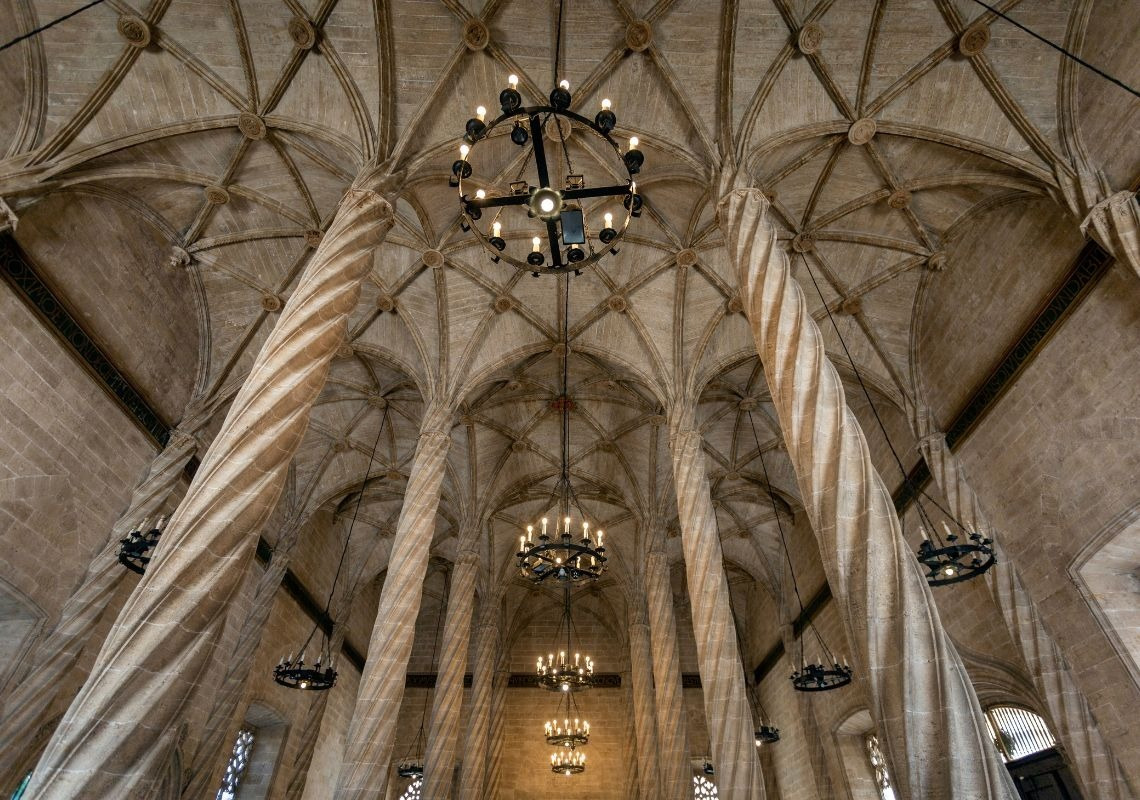
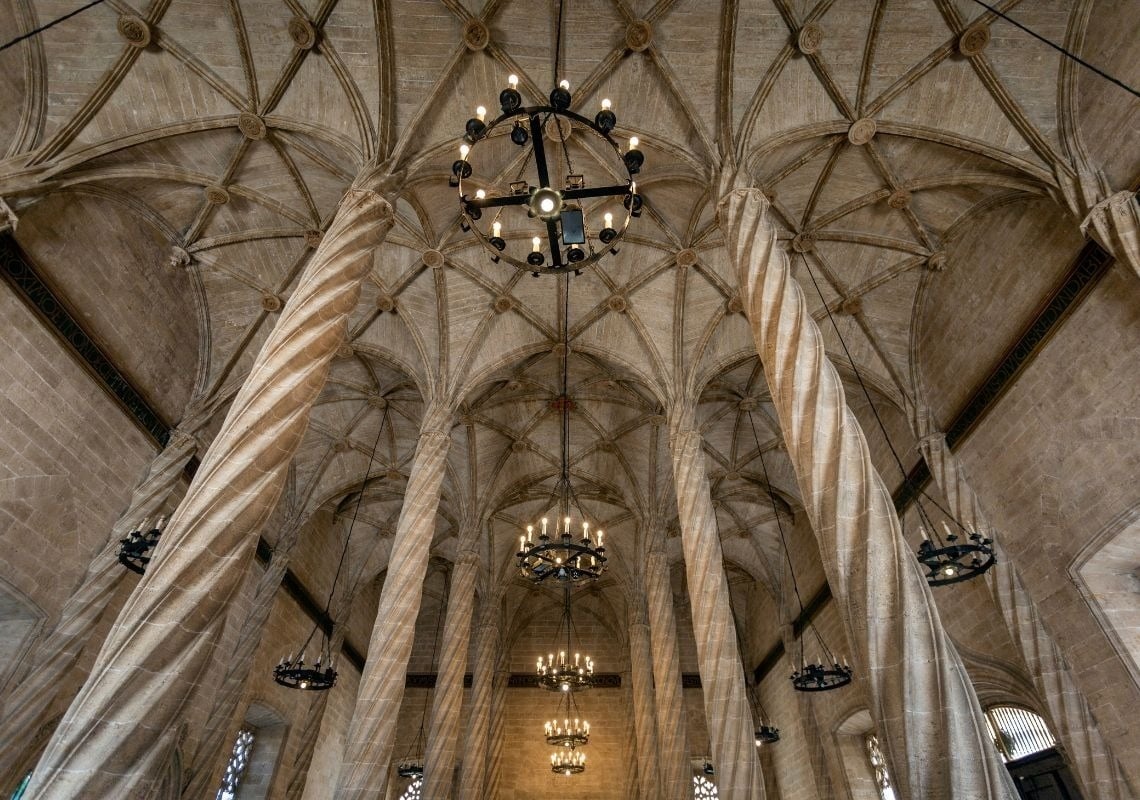
The Trading Hall, the heart of the Lonja, is a vast hall where commercial transactions were carried out. To convey that grandeur, it has eight helical columns that simulate trees, symbolizing the prosperity and growth of trade. These columns support the 17.5-meter-high ribbed vaults, which give the room monumentality. On the walls, you can read inscriptions in Latin that remind merchants of their duty not to act with greed.
The Tower, adjacent to the Trading Hall, housed the jail where merchants who did not pay their debts were locked up, as well as a chapel dedicated to the Immaculate Conception. Currently, it cannot be visited due to a lack of facilities.
Finally, the Sea Consulate was the space where mercantile trials were held. This institution was one of the first to regulate maritime trade in the Mediterranean. Architecturally, it has a rectangular floor plan and a Renaissance style.
The hewn stone façade, the sculptures and gargoyles, as well as the proportions of the doors and windows, reflect the splendor of the era.
Visit the Lonja de la Seda
You cannot leave Valencia without visiting the Lonja de la Seda. You will like it whether you are a lover of architecture or history. It evokes a glorious past and remains a symbol of Valencian identity that shows the refined artistic taste of the Valencian bourgeoisie.
To visit it, you can do so from Monday to Saturday from 10 am to 7 pm, and on Sundays and holidays from 10 am to 2 pm. The ticket price is 2 euros (1 euro reduced admission), and it is free on Sundays and holidays.
Valencia